In the last decades, the global conversation about population movement has shifted from only focusing on those who migrate to considering the equally relevant concept of immobility, the drivers that prevent individuals from moving even when they have strong reasons to do so. This is a distinction that takes on an especial sense of urgency in settings demarcated by protracted instability and war, where both migration and the absence of migration have dire consequences for individual well-being and national stability.
Afghanistan is perhaps the most complex case of population displacement and immobility in the international community. The nation has been marked by war and political instability for more than four decades, creating immense migration flows. There have been six migration waves from Afghanistan. First, the pre-1979 migration. Second, the migration between 1979-1989 due to the Soviet Union’s attack on Afghanistan. Third, the civil war period between 1989-1996 in Afghanistan which resulted in another wave of emigration from Afghanistan. Fourth, emigration during the first Taliban regime between 1996-2001. Fifth, the migration between 2001-2021 which was a period of emigration from Afghanistan and immigration to Afghanistan. The sixth and last wave of emigration from Afghanistan was in 2021 after the US and its allies withdrawal from Afghanistan (EUAA, 2022; Moghadam & Jadali, 2021; Naseh, 2025; Siavoshi, 2024). According to reports, afghan refugees are the third largest displaced populations in the world (Azimi, 2024).
It is essential to consider that while a large number of Afghans emigrated during the above-mentioned waves of migration, millions of Afghans could not migrate in those difficult times due to different immobility factors. Furthermore, both migration and immobility have impact and consequences on the migrants, immobile populations, and on peace.
Drivers/Factors of migration and immobility:
There are various factors influencing people's decisions to migrate from Afghanistan or to remain, whether voluntarily or due to an inability to migrate (immobility).
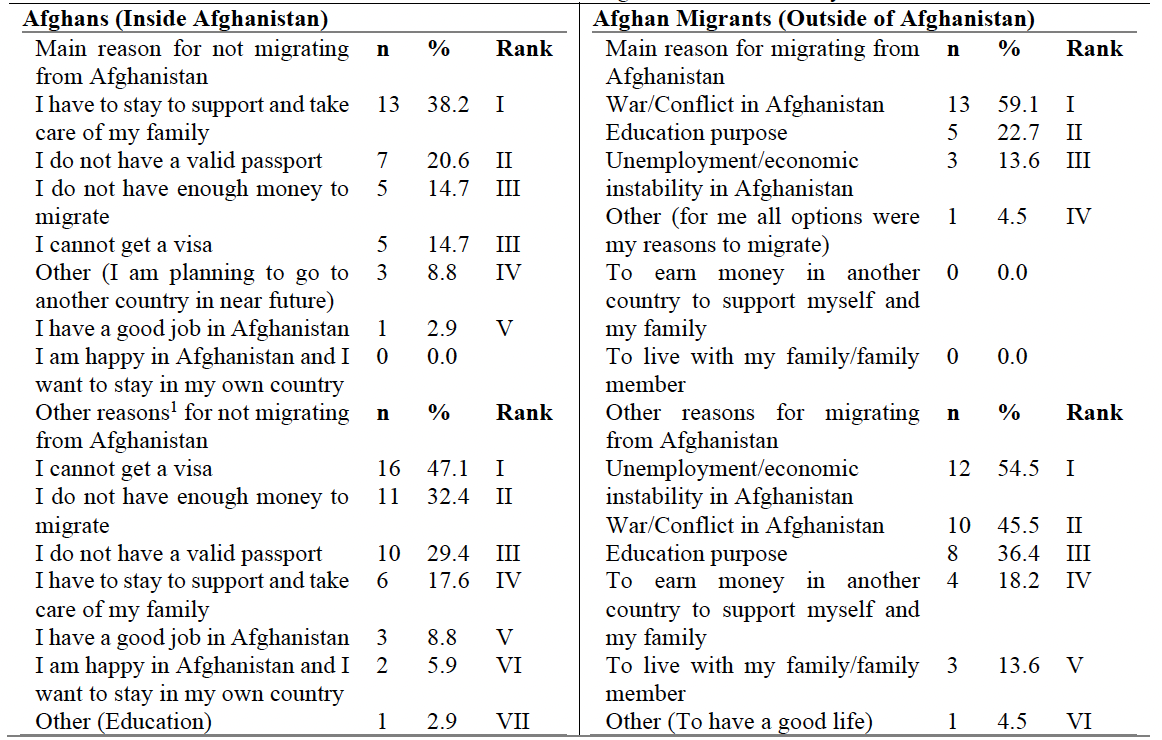
Table above presents the main (primary) reasons for not migrating from Afghanistan: supporting and caring for family (38.2%), lacking a valid passport (20.6%), insufficient financial resources to migrate (14.7%), and the inability to obtain a visa (14.7%). Secondary reasons, ranked from highest to lowest frequency, include the inability to obtain a visa (47.1%), lack of financial resources (32.4%), lack of a valid passport (29.4%), and remaining to support and care for family (17.6%).
In Afghanistan, it is a cultural norm for multiple generations to reside together; adults often remain in the same household with parents and siblings even after marriage and having children. This preference has persisted for decades. Furthermore, Afghan households typically depend on the income of the head of the household, although some families have multiple earners. Given this context, family ties emerge as a primary driver of immobility due to two factors. First, the individual most capable of migrating is often the household's sole breadwinner. This person cannot easily migrate and leave their family behind, as settling in a new country and establishing an income is a time-consuming process. Second, the prospect of migrating and living alone in a new society is particularly challenging for individuals who have lived within a close-knit family structure their entire lives. This challenge is even more pronounced for women due to prevailing cultural norms.
Another significant barrier currently impeding migration is the difficulty of obtaining or renewing a passport. Following the political changes in August 2021, Afghanistan has faced persistent administrative issues in passport issuance, preventing citizens from crossing borders legally. Additionally, the high cost of migration is a prohibitive factor. With the majority of the population living below the poverty line and surviving on daily or monthly wages without savings, most families cannot afford the expense of legal migration. Furthermore, visa access is severely restricted. Currently, Afghans can only apply for visas at four embassies: Iran, Pakistan, Russia, and Turkey. Of these, Russia and Turkey primarily issue student visas, while Iran and Pakistan issue medical, student, and occasional tourist visas under very stringent conditions. Most other embassies remain closed or do not provide services to Afghan citizens, further contributing to involuntary immobility.
The number of participants staying in the country voluntarily is very low. Primary reasons for voluntary stay include those who intended to move in the future (8.8%) and those holding a good job in Afghanistan (2.9%). Additional reasons cited were job satisfaction (8.8%), being happy in Afghanistan (5.9%), and education (2.9%). While voluntary immobility exists, these findings suggest that the proportion of individuals choosing to stay is minimal compared to those facing involuntary immobility.
The table above also details the primary motivations for migrating from Afghanistan: war and conflict (59.1%)–consistent with the findings of İçduygu and Karadağ (2018), as well as Kuschminder (2018)–followed by education (22.7%) and unemployment or economic instability (13.6%), which aligns with the work of Wickramasekara and Baruah (2013). Additional motivations include unemployment and economic instability (54.5%), war and conflict (45.5%), education (36.4%), earning money to support family (18.2%), family reunification (13.6%), and seeking a better quality of life (4.5%).
War and conflict have been central issues in Afghanistan for over 40 years, negatively impacting every aspect of life. These conditions have led to the loss of family breadwinners and a weakened economy, forcing many below the poverty line. Consequently, households often decide to send one member abroad–to countries such as Iran–to work and send remittances back home. Pursuing higher education is the second most common driver for migration. Young people often move abroad for studies and frequently remain there to work after graduation to support their families. Due to economic instability at home, many are reluctant to return and risk the value of their education and professional efforts.
Unemployment and economic instability are issues that people in Afghanistan have dealt with for a long time, and it is linked to the war and conflict in the country (Human Concern International, 2023). This is one of the main reasons for migrating to other countries for people in Afghanistan (Amu TV, 2024). Another factor identified in this research–though cited as a secondary rather than a primary reason–is migration for the purpose of reuniting with family members, though this occurs relatively infrequently in the Afghan context.
Source: Hakeemi, M. (2026). Migration and Immobility in Afghanistan: Understanding Drivers, Consequences, and Their Implications for Peace. European Scientific Journal, ESJ, 22(37), 34. https://doi.org/10.19044/esj.2026.v22n37p34