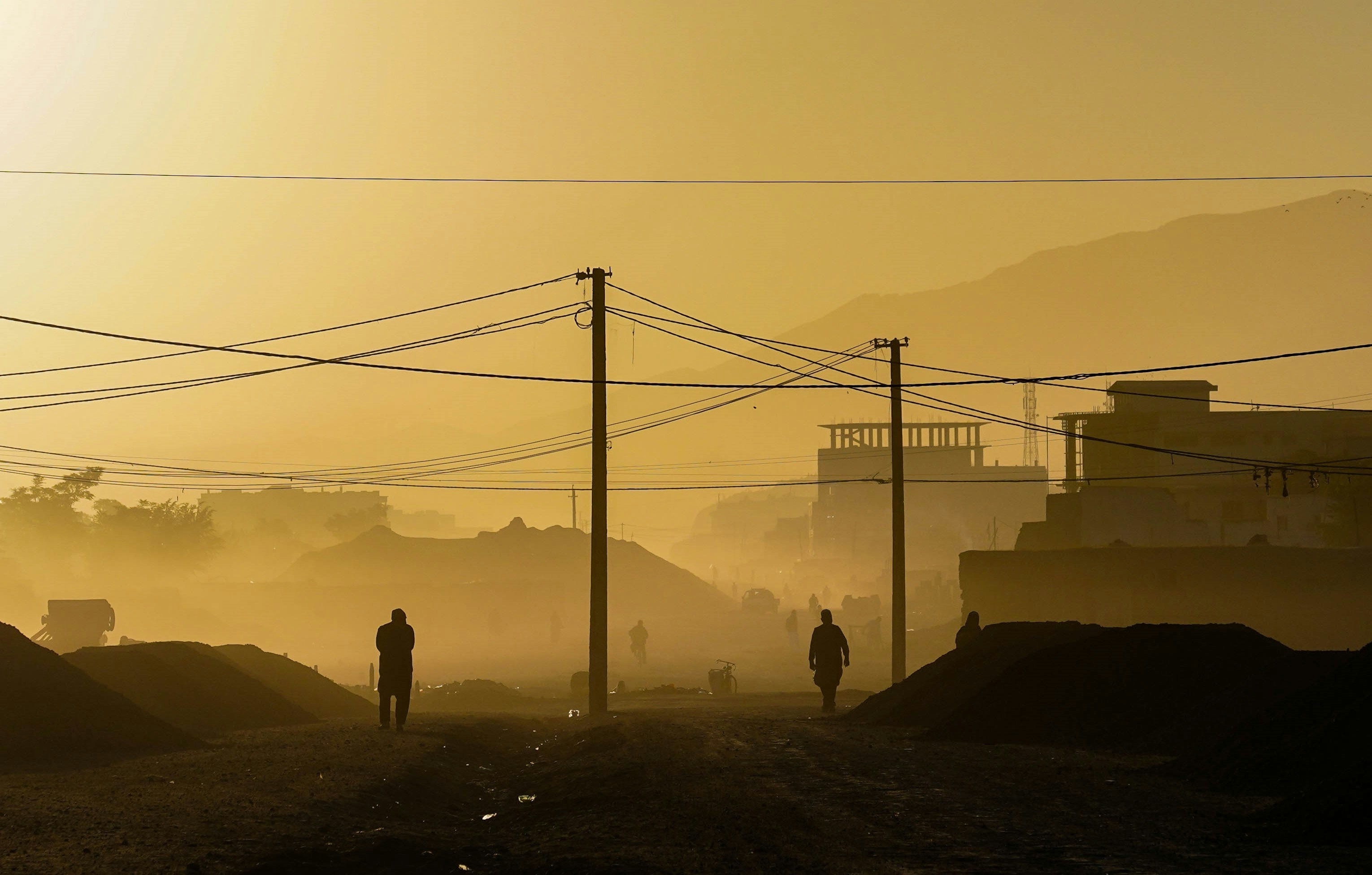
Afghanistan is vulnerable to natural disasters and climate hazards due to its geographical location. The country is ranked 8th out of 170 countries regarding its vulnerability to climate change over the next 30 years. Afghanistan has experienced significant population movements throughout the 21st century, including migration out of the country, the return of refugees, and large-scale internal displacement. People in Afghanistan are extremely vulnerable to disasters because of the country’s low level of socioeconomic development and high level of insecurity, which result in the loss of lives, property, and livelihoods (Spink, 2022).
In this article, I will discuss the three natural disasters and climate hazards ranked highest in Afghanistan by the IDMC in terms of the number of people displaced and their impact: drought, floods, and earthquakes. Then, we will discuss the response of government bodies and INGOs to these hazards and internal displacement. Finally, we will provide a conclusion for this paper.
Drought
An increase in drought is one of the key environmental drivers of displacement and migration in landlocked Afghanistan (Sayed & Sadat, 2022). The dry climate, lack of vegetation, and agriculture dependent on rain make the country sensitive to drought (Redaelli, 2011). Continuous drought events and irregular climatic shocks seem to result in below-average harvests in Afghanistan, which threatens to further increase the food insecurity crisis (WFP, WFP Afghanistan Situation Report, 2022).
While most of the country has suffered from the climate risk of rainfall-related drought over the past 30 years, the North and parts of the Central Highlands are the main areas of concern regarding the negative impacts of drought on food security. In these areas, farming is highly dependent on rainfall; therefore, a decline in spring rainfall has a direct impact on households’ ability to produce food and earn income. Another issue is the reduction in winter snowfall in parts of the Hindu Kush mountains, which results in snowmelt-related drought that primarily affects Kabul and surrounding regions. Large populations live in these areas, which produce much of Afghanistan’s vegetables, fruits, and cereals; furthermore, these regions are heavily dependent on irrigation from the Kabul River and its tributaries, which are partly fed by snowmelt from the Hindu Kush (WFP, UNEP, & NEPA, 2016).
One of the years in which drought affected Afghanistan the most was 2018; over 170,000 people were displaced in the western region alone due to food insecurity caused by drought (ATR, 2021). In that year, droughts left almost 4 million people in need of food and livelihood support; these droughts affected two-thirds of the country, and Afghans displaced that year were moved more by environmental and natural disasters than by conflict. A lack of equipment and resources to cope with the impact of climate change caused some farmers to make desperate decisions; some even considered selling their young daughters into marriage. Others migrated to big cities within the country or to neighboring countries (Sayed & Sadat, 2022).
Floods
Violent floods destroy homes and crops and take the lives of hundreds of people every year. In August 2020, Parwan Province, north of the capital, witnessed a day of floods that killed more than 70 people. The following year, in the eastern Nuristan Province, a week of floods killed more than 100 people. People who survive these types of floods tend to be displaced temporarily and return when the situation improves (Sayed & Sadat, 2022).
Floods caused by heavy spring rainfall have negative impacts across different livelihood zones in Afghanistan, specifically the northeast, the center of the country, the southeast, and the southern provinces. In these areas, livelihoods are dominated by agriculture and pastoralism, both of which are highly sensitive to flooding. Furthermore, riverine floods caused by increased snowmelt in the spring have direct impacts on livelihoods along rivers in the eastern part of the Helmand River basin, making the area vulnerable (WFP, UNEP, & NEPA, 2016).
Severe flooding due to climate change has also had an impact on driving hunger. As of May 2022, half of the population was considered extremely food insecure, meaning their lives or livelihoods were in immediate danger (Sayed & Sadat, 2022). Between July and September 2022, unseasonal flooding affected 21 provinces. While there were lower levels of flooding in the spring of 2022 compared to the previous five years, summer floods (June to September) caused noticeable disruption to agricultural livelihoods, affecting crops before harvest and disrupting regular cycles (IFRC, 2023).
Earthquakes
Earthquakes are also reasons why people are forced to leave their houses and property. In 2022, three major earthquake events caused loss of life and property damage in Badghis Province (January), the Southeastern Region (June), and Kunar Province (September). A 5.9 magnitude earthquake on June 22 struck Paktika and Khost provinces, destroying hundreds of houses and killing more than 1,000 people (WFP, WFP Afghanistan Situation Report, 2022). Another earthquake occurred on March 21, 2023, which worsened living conditions in Northeast Afghanistan (IFRC, 2023).
All of these earthquakes have displaced thousands of people either temporarily or permanently. Regarding the impact of displacement, research conducted in Khalyan village (Takhar Province) and the Shaiday IDP camp (Herat Province) found that migration due to climate factors had a negative impact on lives; participants reported they could not find good jobs or better opportunities after being displaced. Unemployment, family separation, dangerous journeys, debt, and continued hardship were all negative results of forced migration according to this research (Spink, 2022).
Internally Displaced Persons Due to Climate Change and Disaster
People are internally displaced due to disasters and climate change from affected areas to other places where they reside temporarily or permanently. The table below shows the data for disaster events and the number of displaced people in the past 10 years (2012–2022) as reported by the Internal Displacement Monitoring Centre (IDMC).
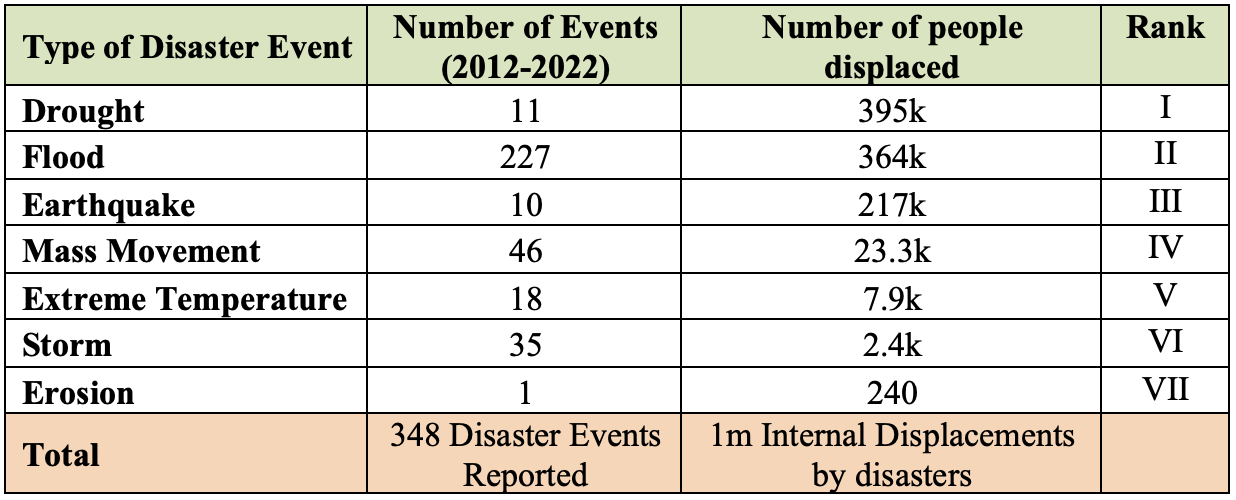
From the table above, we can see that a total of 1 million people were internally displaced by disasters due to 348 reported events between 2012 and 2022. Drought is ranked first, displacing 395,000 people during 11 events. Flooding is ranked second, displacing 364,000 people across 227 events. There were 10 major earthquakes displacing 217,000 people. During these 10 years, 46 dry and wet mass movements were reported, displacing 23,300 people. Extreme temperatures displaced 7,900 people across 18 events, while 35 storms displaced 2,400 people. Finally, one erosion event was reported, displacing 240 people (IDMC, 2022).
Government and NGOs Response
Supporting IDPs is primarily the responsibility of their government (Holloway et al., 2022). In Afghanistan, two government bodies are responsible for managing displacement: the Office of the State Minister for Disaster Management and Humanitarian Affairs, and the Ministry of Refugees and Repatriation (MoRR). Initial emergency response is managed by the Office of the State Minister, which is responsible for the first 72 hours of displacement due to natural disasters. After these three days, the MoRR takes responsibility for all displaced persons.
The MoRR is responsible for internal displacement, the return of refugees, and reintegration. It shares responsibility with sectoral ministries; for instance, the Ministry of Urban Development and Housing works with the MoRR to create infrastructure supporting growing urban populations resulting from rural-to-urban migration (Spink, 2022).
IOM
The International Organization for Migration (IOM) works in Afghanistan to support vulnerable people in disaster-prone areas. The IOM tries to prevent the worst impacts by building small-scale disaster risk management (DRM) infrastructure, such as gabion walls or irrigation systems, and implementing Community-Based Disaster Risk Management (CBDRM). The IOM collaborates with stakeholders and diaspora communities to make the voluntary return of IDPs possible with safety and dignity (IOM, 2023).
WFP
The World Food Programme (WFP) provides food, nutrition, and livelihood support. For example, within hours of the June 22 earthquake, a convoy of WFP trucks distributed 170 MT of high-energy biscuits to 2,600 households (WFP, WFP Afghanistan Situation Report, 2022).
ARCS & IFRC
The Afghan Red Crescent Society (ARCS), supported by the International Federation of Red Cross and Red Crescent Societies (IFRC), is a primary national partner. ARCS facilitates disaster preparedness with 34 provincial branches and a network of 24,600 volunteers. The IFRC supports ARCS in humanitarian operations and delivering assistance to affected populations (IFRC, 2023).
Conclusion
Afghanistan is prone to climate change and disasters due to its geographical location. Due to these climate and disaster events, a total of 1 million people were internally displaced either temporarily or permanently from their place of residence. The three biggest drivers of displacement in Afghanistan over the period of 10 years from 2012 to 2022 were: Drought, Floods, and Earthquakes. Alongside the government, international NGOs and institutions like IOM, WFP, and IFRC also support vulnerable communities and IDPs in Afghanistan.
References
Assess Transform Reach Consulting. (2021). Re-imagining the drought response: Lessons learned and recommendations. Asia Displacement Solutions Platform.
Holloway, K., Ullah, Z., Ahmadi, D., & et al. (2022). Climate change, conflict and internal displacement in Afghanistan. HPG Case Study. https://www.odi.org/en/publications/climate-change-conflict-and-internal-displacement-in-afghanistan-we-are-struggling-to-survive
IFRC. (2023). Operation update: Afghanistan | Humanitarian crises. International Federation of Red Cross and Red Crescent Societies.
International Organization for Migration. (2023). IOM comprehensive action plan for Afghanistan and neighbouring countries. https://www.iom.int/
Redaelli, S. (2011). Research study on IDPs in urban settings: Afghanistan. The World Bank.
Sayed, N., & Sadat, S. H. (2022, June 29). Climate change compounds longstanding displacement in Afghanistan.Migration Policy Institute. https://www.migrationpolicy.org/article/climate-change-displacement-afghanistan
Spink, P. (2022). Climate change drives migration in conflict-ridden Afghanistan. ActionAid International.
The Internal Displacement Monitoring Centre. (2022). Global internal displacement database. https://www.internal-displacement.org/database/displacement-data
World Food Programme. (2022). WFP Afghanistan situation report. https://www.wfp.org/countries/afghanistan
WFP, UNEP, & NEPA. (2016). Climate change in Afghanistan: What does it mean for rural livelihoods and food security? World Food Programme, United Nations Environment Programme, and National Environmental Protection Agency.